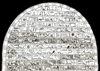
Stela bears an offering formula
Carved limestone stela.
BM EA 567 begins with a date, an offering formula, and then moves onto a full set of the twenty elements of the Abydos formula, of which a selection are given here, including some mentioning the Abydos mysteries.
The Abydos formula is a fairly standardised set of afterlife wishes. The mature version belongs to the first half of the 12th dynasty with earlier (less standardised) versions occurring in the 11th dynasty. The full formula has twenty elements.
|
|
Inscriptions on the Monument
|
|

Transliteration
( If the Hieroglyphic,Demotic or Hieratic text is not appearing clear, install this file )
rnpt-sp 13 xr Hm n
nsw-bity nbw-kAw-ra
di anx Dt r nHH
Htp di nsw
Asir nb Ddw xnty-imntw nb AbDw
wp-wAwt xnty AbDw
Hqt Hna Xnmw
nTrw nb AbDw
di=sn prt-xrw
t Hnqt kA Apd Ss mnxt
xt nbt nfr(t) pr(r)t m-bAH nTr aA
ms.t(w) n=f awy Xr Htp
m Hb(w) nw Xrt-nTr
Hna Sms(w) n Asir
tp(w)-a xprw Xr-HAt
sAx Tw wr(w) nw Ddw
Snyt imt AbDw
Dd.t(w) n=f iiw m Htp
in wrw nw AbDw
sDA=f Hna nTr aA
m DAt-nTr r r-pqr
nSmt wrt r nmtt=s
m Hb(w) nw Xrt-nTr
sdm=f hnw m r n tA-wr
hAkr grH n sDrt
m sDryt nt Hr-Sn
Translation
Regnal year 13 under the person of
the king of Upper and Lower Egypt Nubkaure,
given life enduringly and repeatedly.
An offering which the king gives
to Osiris, lord of Djedu, Khentyimentu, lord of Abydos
and Wepwawet, the one at the forefront of Abydos,
Heket and Khnum
and all the gods of Abydos
so that he may give a voice offering of
bread and beer, ox and fowl, alabaster and linen,
and everything good which goes before the great god.
May hands be presented to him carrying offerings
during the festivals of the necropolis
along with the followers of Osiris,
the ancestors who existed before.
May the great ones of Djedu
and the entourage in Abydos enspirit you.
May ‘Welcome in peace’ be said to him
by the great ones of Abydos.
May he travel with the great god
during the god’s journey to Ro-Poker,
when the great Neshmet-bark is at its journeys
during the festivals of the necropolis.
May he hear jubilation in the mouth of Tawer
(at) the Haker-rites of the night of vigil
during the vigil of Horus-Sn
| M. Collier, B. Manley, How to read Egyptian Hieroglyphs, (London, 1998), 119 |